PHOTOGRAMS AND LUMEN PRINTS FOR BEGINNERS

The day came to do our first experiences. So the class was divided in two groups so we could work at the same time without to much of a mess. So half did photograms (inside the lab, just because we had one available, it’s not mandatory) and half lumens (outside, in the sun).

Let’s start by defining what this is, shall we?

Photograms ar photographies as we know them, only they are made without a camera and the colors are reversed (what had light on turns black, what doesn’t stays white) so they are almost like a shadow of what was placed on top of the paper. Photograms are presente since the begining of photographies history, and were givem many diferente names by each one of the people that tried, rediscovered or used them. Beacause, as i recall from my last post, it is impossible to give credit to jus tone person for this process.

The history of photography is punctuated by practitioners who have developed a technique or style that has become a part of art history.  The first period of “photogram” exploration was to gain scientific record of natural objects (e.g. Anna Atkins).  The second period was a rediscovery of the artistic potential as illustrated by Christian Schad, Man Ray and Lazlo Moholy-Nagy in the Dada, Surrealist and Constructivist periods of art, respectively.

Wedgwood called them light profiles.
Fox-Talbot called them photogenic drawings.
Niépce called them heliographism.
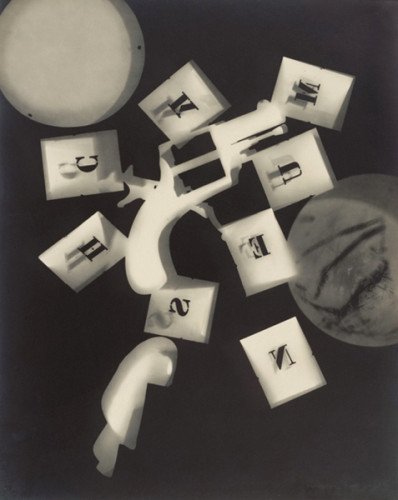
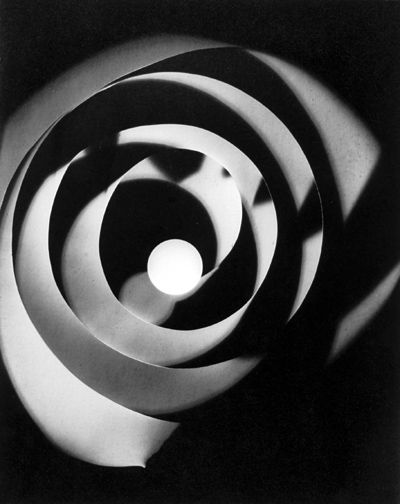
Man Ray called them rayograms.

Although i have to admit to have Man Ray’s rayographs has an all time favourite.

Man Ray made his “rayographs” without a camera by placing objects-such as the thumbtacks, coil of wire, and other circular forms used here-directly on a sheet of photosensitized paper and exposing it to light. Man Ray had photographed everyday objects before, but these unique, visionary images immediately put the photographer on par with the avant-garde painters of the day. Hovering between the abstract and the representational, the rayographs revealed a new way of seeing that delighted the Dadaist poets who championed his work, and that pointed the way to the dreamlike visions of the Surrealist writers and painters who followed.
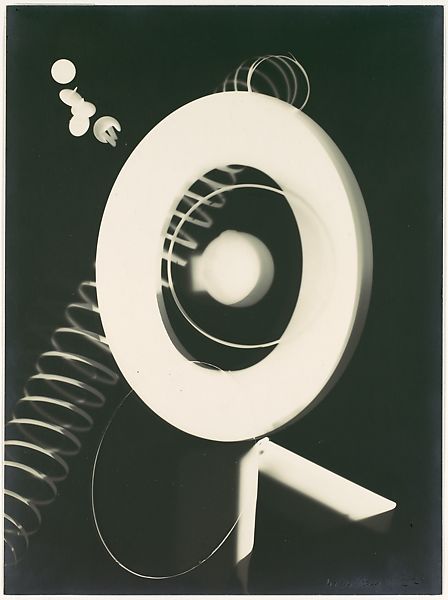
Image 1 – One of Man Ray’s many rayographs.

My photograms

I will post this as if it was a recipe for food, because it helps me explain it and also i think it will help me understand it when the time comes to repeat the experience.

Now, first recipe:

  • Source of controled light (we used photography amplifiers beacuse they have timers included, but a regular lamp and a chronometer will do just fine, it’s not an exact art)
  • Photosensitive paper (Ilford worked just fine)
  • Objects (this time bi or tridimentional, because ther is no need to flaten them, so i had a necklace and some plastic letters, and yes, i stole the idea from some of Man Ray’s photograms)
  • Usual chemicals (developer, stoping bath, fixer and tap water)

Preparation:

Pretty much just adding the right amount of water to each chemical (following the manufacturer’s instructions) and putting them in order and separate containers.)

Process:

You can do photograms in basically any kind of light sensitive paper. We used silver ones (they turn into black when exposed). You place the paper in a surface and the objects on top of if. Place the light above them and figure out how much time you want to expose it, just through several small attempts. Keep in mind that transparent objects will require less light to go through and more dense ones will require a lot more time. But it is a quite experimental process, and a lot of fun to just do a bunch of small tests, and prepare yourself (or your timer) to countdown!

Count the SECONDS and turn of the light. You don’t see any image yet, normal. Grab that pape rand put it insider de developer container, and gently move the container around to cover the whole paper surface equally. After some time the image will start to show. After 2 minutes, move the paper into the stop bath (wich alters the pH and stops the developing process) for 30 seconds. Finally do the same thing but in the fixer, wich will remove the unexposed (silver in this case) cristals, thus making your image permanent.

The whole process is quite fascinating and it really helps us to understand where photography is coming from.

So, when i tis exposed to ligh, the silver cristals in the surface of the paper will get tiny craks, then the strong reducer present in the developer reduces the silver to the metalic state. The afterwards bath is the stopping bath, wich basically inhibits the reducer action in the surface so the revalation stops before we move to the fixating bath wich fixates the image by dragging and removing the remaining cristals that were still waiting to be used. This way the cristals that “saw” light turned darker and the ones that did not,were removed, and the paper stays as white as it was when manufactured. The ones that were not craked, did not combine with the revelatory chemical and were later washed out by the fixator.

I absolutely loved this class. The process, although simple, was my first ever contact with the chemicals and photography labs. It helped me understand how the chemicals work, and seeing the image being born was magical.

I just took the opportunity to have fun and experiment a lot with different materials, with different timings in the light and different densities. I cut some larger papers into tiny pieces so I could do smaller, but more experiences.

One of the ones I love the most is one that I (stupidly) exposed the paper in the worng side. So, when I placed the paper inside de revelator, it did nothing, it wasn’t exposed. Instead of throwing it away I took it out, shook it and placed it under light again (still soaked in chemical, and yes, I know how stupid it sounds) and then proceeded in the usual way. And my mistake turned out beautiful (just like Man Ray’s Portrait of Marquise Luisa Casati in 1922, caused by a bad tripod that fell of in the decisive moment, giving her 4 eyes). But in this case beacause instead of black, it turned into a beautiful shade of grey and strong white, looking like a strange x-ray.
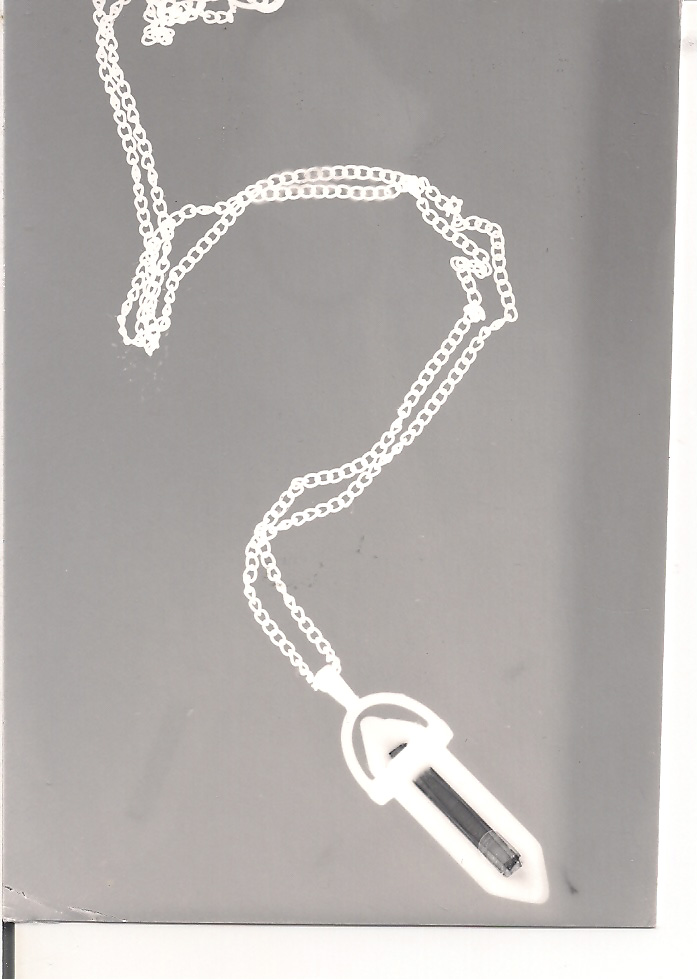
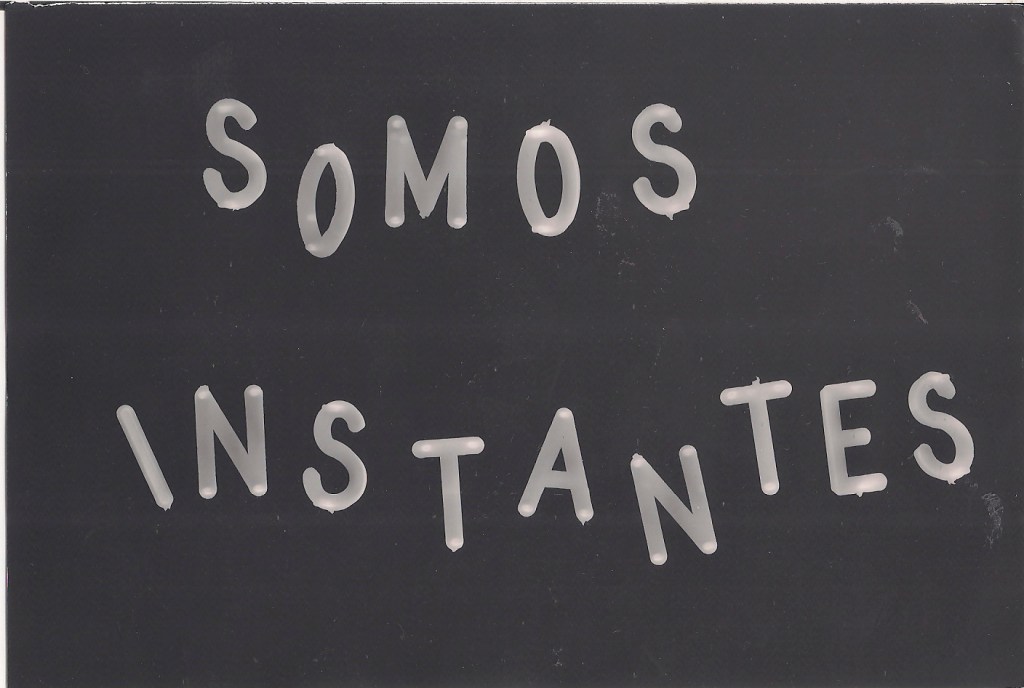
Image 2 – My beautiful mistake (wrongly exposed image for 4 seconds with 5,6 aperture in the amplifier, revealed and then exposed right again for 4 seconds, afterwards revealed, and fixed). The cut in the paper is not even because it was a spare paper someone cut and forgot around the lab and i just felt like i should use it.
Image 3 – A properly done photogram, using plastic letters that i brought from home, 3,5 seconds of light was enough here). It looks kind of dirty but it was acctually the scanner, the original is perfect.
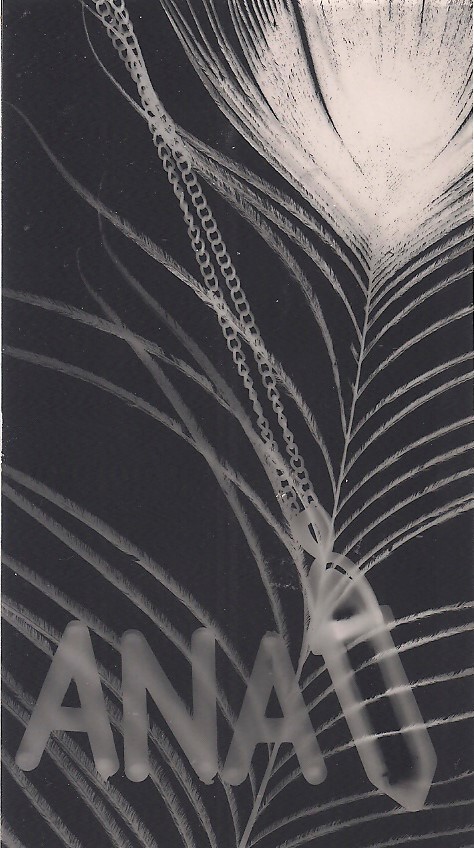
Image 4 – experiment with materials that have different densities, feather, metal an glass necklace and plastic. This one i did under 4,5 seconds of light, and it is a really small piece of paper.

I always loved the black and white colors, so it would be hard for me to not like these. The contrast was better acomplished in the last two images of course, and I assumed these timings in the light were proper has i could see through the different densities materials and still have perfect white, and perfect black in the same image. Of course the paper also behaved beauthifully (it was a comercial grade) and it was matte wich brings out the dark tones.
HISTORY OF EXPERIMENTAL PRINTS

(The shortest verison I was able to create)

So we started this shcool unit with it’s logical birth, history.

But alow me to begin with a conclusion: Photography doesn’t have just one story but serveral that converged, although their starting point had it’s origin in mutiple country with distinct influences.

“But someone has to have been the first, someone had to beat someone else to it”. Well, oppinions diverge on this matter. But let’s all agree that photography needs 3 things, and only these 3 to exist:

  1. Light
  2. Object
  3. Photosensitive material

So, since that light and objects exist since the dawn of time. We can say that photography started by him who created photosensitive material to print on, thus recording what we see has it is, and not the first camera holder has you would think.

This is why the history of photograpy always shifted between assuming the documental value of images, as a way to just record reality and the way in wich diferente ages put their artistic toe into it, throughout the experience of creating something.

Having said this, there were countless experimental attempts to find photosensitive materials to produce what were originally called “photogenic drawings” meaning drawing created by light. These attempts pre-dated the existance of cameras and pretty much worked by: coating commonly available materials such as glass, metal, paper and even leather with light-sensitive chemicals.

The first chemically photographic process can be considered a photogram.

Important names in the history of printing

Johann Heinrich Schulze (1687-1744) –  German physicist and professor of anatomy and medicin, found that silver nitrate in a jar, when left exposed to sunlight, turned dark on the side facing the window. After exposure, if the bottle was shaken, fresh silver nitrate replaced the exposed material near the glass surface. Schultze first demonstrated that this action was caused by light and not by heat. Schultze’s experiment failed to result in a permanent image because exposure to light continued to change the unfixed silver.

Thomas Wedgewood (1771-1805) – Chemist, physicist and son of the potter and industrialist, Josiah Wedgewood. By experimenting with chemicals in his father’s shop was able to produce only temporary images. He is known to have produced designs on leather, glass and ceramic items. Wedgewood called these images “sun prints” a term that has survived until today. His work also failed to produce permanent images due to his inability to fix the image.

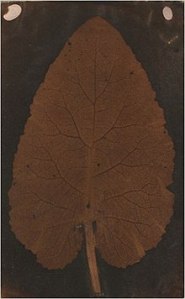
Leaf -
It is believed to have been photographed by Wedgewood for several reasons, one of them the W letter on the right upper corner of the image. Although it is a controversial matter, it is one of the first photograms in history.
Salted paper photogram of a leaf, circa 1839.
A speculative attribution to Wedgwood in 2008 was later retired. Although this is a controversial matter, it is one of the first photograms in history.

“No attempts have been made to prevent the uncolored parts of the copy or profile from being acted upon by light have yet been successful”

Thomas Wedgewood

 “The copying of a painting, or the profile, immediately after being taken, must be kept in an obscure place. It may indeed be examined in the shade, but, in this case, the exposure should be only for a few minutes, by the action of candles or lamps, as commonly employed it is not sensibly affected.”

Humphrey Davy

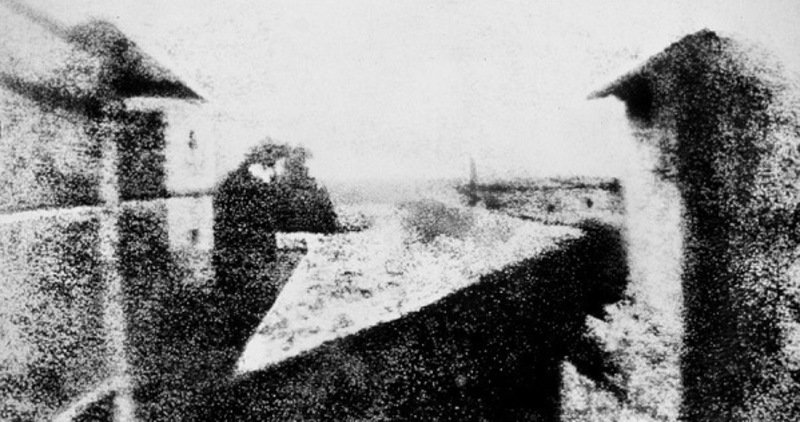
Joseph Nicephere Niepce, in France, in 1824 created a recorded image of a drawing by coating a sheet with Bitumen of Judea, a type of asphalt. By exposing through the drawing, and washing off the soft unexposed asphalt resulted in a photogram copy of the drawing. Niepce continued to explore ways to improve his process without significant success. He abandoned the concept and experiments and later worked with Louis Jaques Mande Deguerre on the Daguerreotype process.

Joseph Niepce – Point de vue du Gras, 1826/1827
The photography took 8 hours of exposure to sunlight.

William Henry Fox Talbot (1800-1877) – English scientist and mathematician, while traveling in Italy in the early 1830’s used a camera lucida (a portable camera obscura) to draw nature and because of the difficulties in detailing various subjects, he decided to investigate the use of photography as a way to capture the details.

Talbot began investigating the properties of silver salts in mid-1834 and in 1835 and part of the process was to expose to sunlight until an image appeared, followed by washing the print in salt solution under low level of light, resulting in a relatively permanent image.

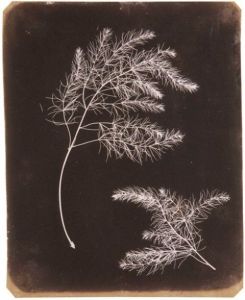
Fox Talbot – Aspargus Foliage, 1840’s

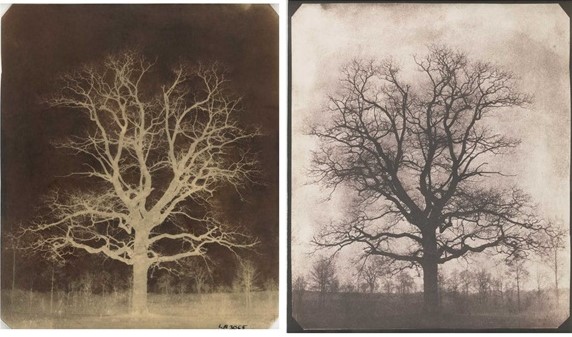
Talbot used the term Calotype from the Greek “calos” meaning beautiful” to describe these images. Talbot was the first person to expose sensitized paper in a camera. Since film was unknown at the time, Talbot oiled the paper to make it transparent and this “negative” was used to produce a positive by contact printing through the oiled paper. Talbot is considered the first person to create a photographic process that produced a negative that could be converted into a positive image.

William Fox Talbot – An oak tree in winter, 1842-1843

He was also the first to manage to fix his photograms, in the salted paper, so his photogram images were the first to survive to this day.

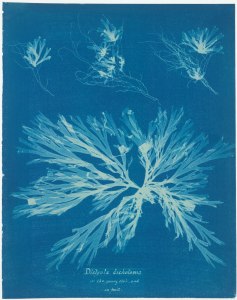
We also owe a great deal to Anna Atkins (1799-1871). Anna, was born in Kent and spent her childhood in the presence of many of the leading English chemists. She helped her father in scientific endeavors. Also, Herschel and Talbot were friends of Anna’s father and thus Anna knew early on about the cyanotype and Talbot processes for creating images. Anna later used the process of making cyanotypes to produce detailed images of botanical specimens, he then used these to illustrate her book entitled “British Algae: Cyanotype Impressions”. This was the first book that was illustrated using photography.  

Anna Atkins – Cyanotype: Dictyola Dicholoma, 1843.
Printed and published Part I of “British Algae: Cyanotype Impressions” in 1843 and in doing so established photography as an accurate medium for scientific illustration.

She learnedn cyanotype and photogenic drawings cooresponding with Fox Talbot and John Herschel. Herschel was a scientist, inventor and astronomer. He invented the cyanotype in 1842 by observing the photosensitivity of ferric salts. He also discovered that sodium thiosulfate would “fix” images and essentially stop images from fading with further exposure to light. The cyanotype became an important and popular method for producing images during the 19th and 20th centuries because of the ease of coating the paper with photosensitive solution and because the image can be developed using water.

The cyanotype process is very permanent and many of the photograms produced in the mid-1800s survive today.

As the method was perfected throughout time, it started to be used has a mein of art. In this fase i should like to give some final, but special attention to one who was one of the biggest influences in one of my all times favourite photographer.

Man Ray (1890-1976) – This american was one of the founders of the Dada movement (anti-art, ilogical and absurd), alogside with Michael Duchamp. In 1921. In Paris he comes across surrealismo (wich had a strong influence on Freud psicoanalisis, has enphatised the role of the subconsciente in creative activities) and becomes influente in the movement. Man Ray developed lots of experimental works, in techniques such as: Sabatier efect, photograms, multiple exposures and original techniques in photosensitivity and photographic prints.

The process and evolution of photograms is fascinating and experimental, so is it’s own process. Despite the interest, more than everything, the history just made me very curious on how to actually make a photogram or a sun print. Because, the concept seems rather simple, but the time that took for it to develop must require some skills wich i do not, yet, have.

References

Godinho, Maria Margarida A.f. Medeiros M. (2016). Fotogramas : Ensaios sobre fotografia. 1st ed. Lisboa : Documenta, 2016. 224 p. Powered by PureScopus & Elsevier Fingerprint Engine™ © 2019 Elsevier B.V.